Soul Searching in Umbria
Centuries-old estates and sacred spaces are getting a new lease of life as charismatic country retreats, discovers Thomas Midulla, who paid a visit to three of the region’s most ambitious projects and the bucolic villages that frame them.

For more than a decade, Umbria has been tipped as Italy’s next must-visit destination – a quieter, greener alternative to its neighbour, Tuscany. People in the region have put up some resistance to it being cast as Tuscany’s “little sister”, though, at less than half the size and with only a quarter of the population, comparisons are inevitable. Occasional talks of closer cooperation between the two – on water supply, healthcare and infrastructure – have never gone beyond plans on paper. This headstrong insistence on separateness, if not hugely economically beneficial for Umbria, has served as a way to guard its own rhythm and identity.
This is a land of sleepy medieval towns, timeless art and deep-rooted traditions, where taking life slow is a way of staying true to one’s roots. Here, country living remains at its purest, offering the beauty of Tuscany’s rolling hills but with far fewer visitors (the region counted nearly seven million overnight stays in 2023 – against Tuscany’s 46 million).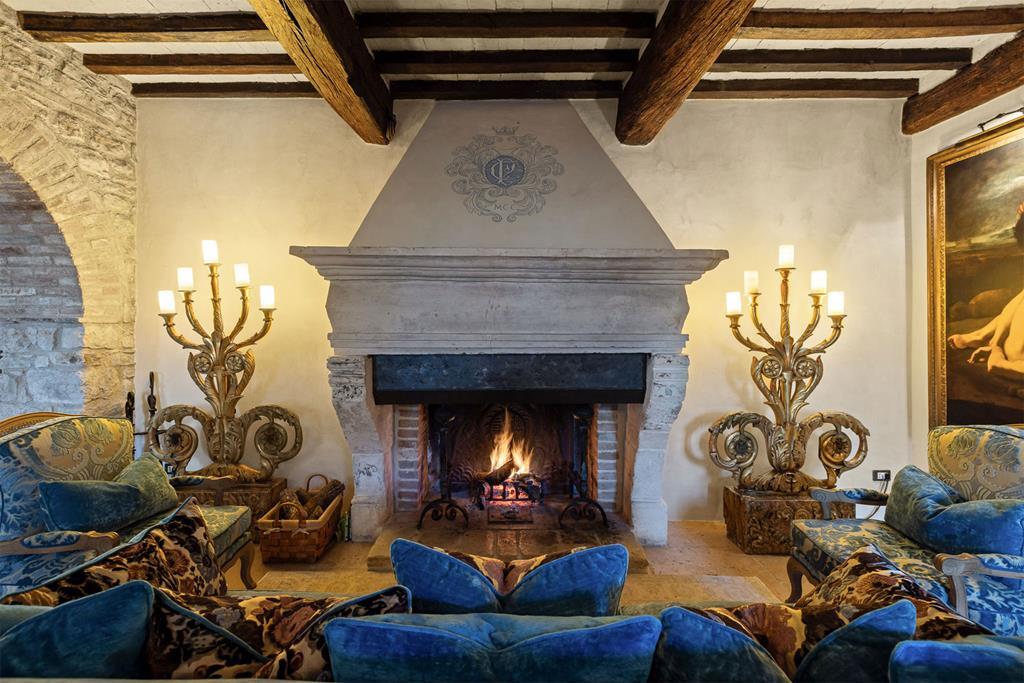 (photo: Castello di Procopio)
Most of the hospitality here remains small-scale, family-run, deeply personal and often low-key. But it was just a matter of time until the region would start catching the eye of industry heavyweights. Mandarin Oriental Exclusive Homes recently added Castello di Procopio, a 12th-century estate north of Perugia, to its portfolio, available only as a fully private rental for up to 16 guests. Six Senses is taking over the reins at Antognolla, already known for its Robert Trent Jones Jr-designed 18-hole golf course and its restaurant, La Boiola. The group will unveil a resort with residences, a cooking school and an organic farm scheduled to open in 2028. And by 2027, Pellicano Hotels Group, under CEO Marie-Louise Sciò, is preparing to open La Badia, a former Benedictine abbey perched above Orvieto.
The ambition is clear: to shine a light on this discreet corner of Italy that still holds its secrets. There are a few visionaries – three couples, to be precise – who are ahead of the curve, paving the way to elevated hospitality in the region.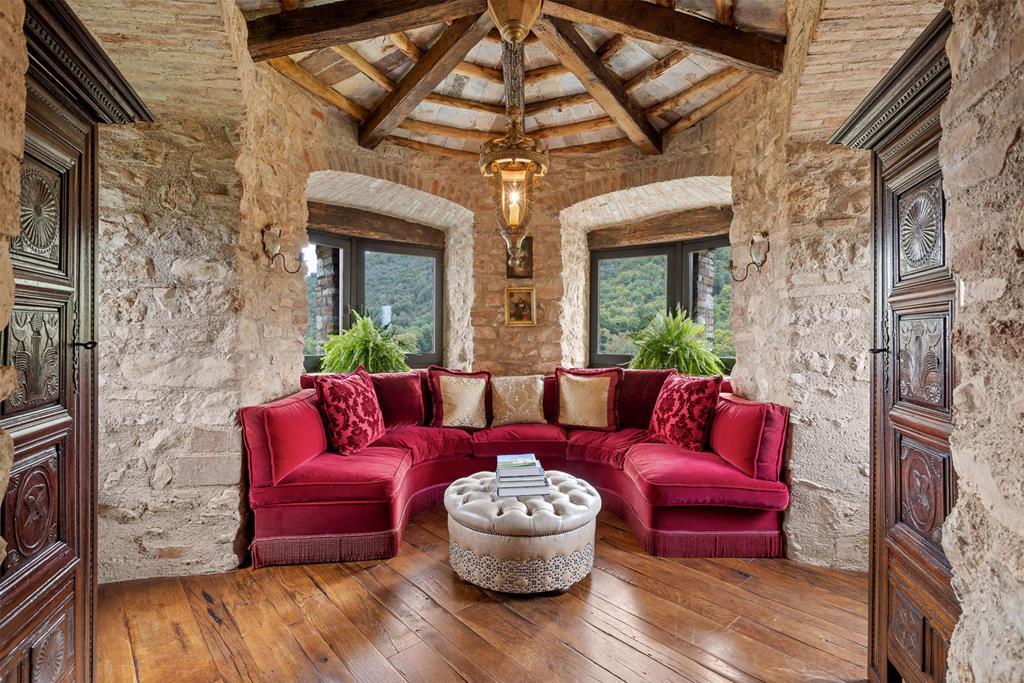 (photo: Castello di Procopio)
Living History
Reschio in Lisciano Niccone offers a bold and highly Instagrammable mix of historical heritage and timeless modernism, with 36 rooms and suites inside an 11th-century castle that once served as a fortified hill settlement during the centuries-long border struggle between the Papal States and the Republic of Florence. Spread across the 1,500ha estate are some 50 additional farmhouses, eight of which are available to rent, while others await restoration and sale.
Once inside the medieval walls of the castle, the scene becomes eclectically cinematic, almost accidental, yet every detail is orchestrated by the owners: Count Benedikt Bolza, an architect, and his wife, Donna Nencia Corsini. Take the Palm Court, for example: a winter garden filled with rattan Peacock chairs and a 1908 Steinway piano. As evening falls, live music drifts through the space while guests sip cocktails before walking up the grand staircase to be seated at the elegant Ristorante al Castello. “This place is an invitation to slow down, to embrace the pace of life people knew in the 1920s and 1930s,” Bolza explains, pointing out portraits, heirlooms and pieces of contemporary design he created himself in La Tabaccaia, his on-site creative workshop.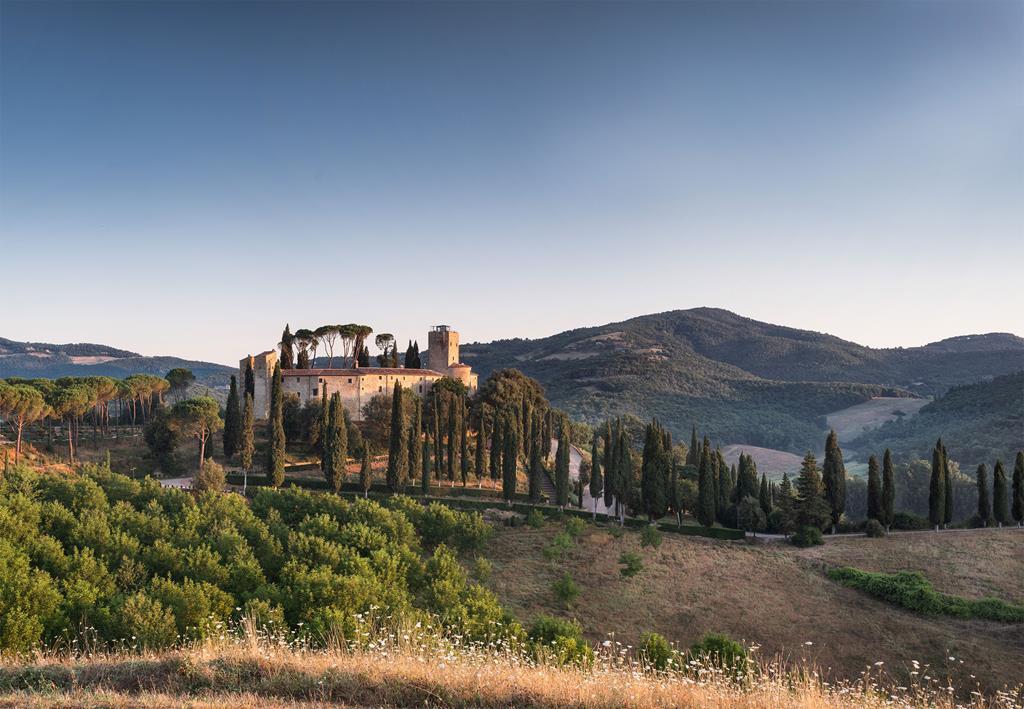 (photo: Reschio)
Guests can browse local specialities and spirits at La Bottega, or shop for antique finds and curated furniture at The Dealership. Days here unfold gently – lounging by the pool, hiking to the lake cabin (a secluded chalet available for day rental), or joining in traditional activities like beekeeping (the estate has 40 hives), flower-dyeing, a swing-dance lesson, or mastering the art of making marbled paper. And then there’s the Bathhouse spa: hidden in the castle’s former wine cellars, it’s less a retreat than it is a theatrical journey for all the senses. Behind every vaulted doorway lies a new surprise: candlelit chambers, a crackling fire, two vast stone baths steeped with wild herbs from the estate, and a secret grotto echoing with Gregorian chants. It is an experience of wonder and discovery, where relaxation becomes a voyage through light, sound and scent.
Nearby, art and culture are never far. Città di Castello, birthplace of late artist Alberto Burri and home to the foundation dedicated to preserving his legacy, is a short 30-minute drive away. Equally close by is Solomeo, the must-visit village revived by fashion entrepreneur Brunello Cucinelli. Locals will tell you he’s often spotted at his favourite haunt, Valter a Solomeo, a family-run trattoria where the speciality is tagliatelle all’impolverata – pasta tossed with cured ham, wild fennel and crisped cubes of bread, a dish that speaks of Umbria’s earthy soul.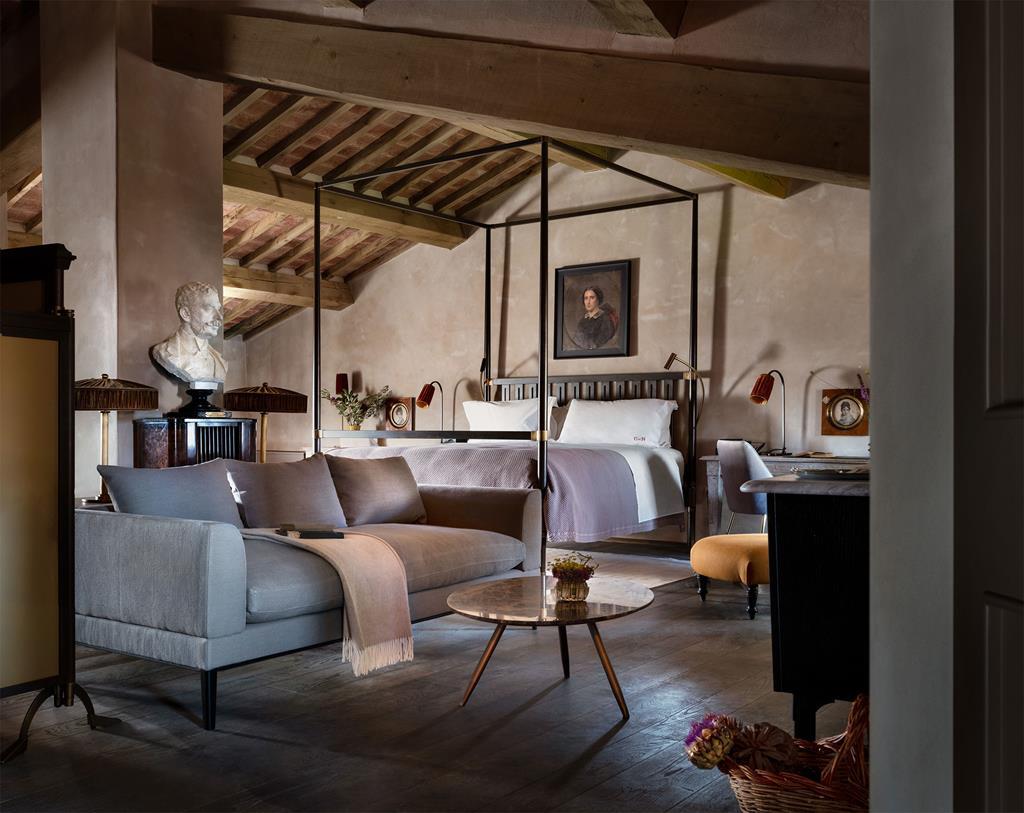 (photo: Reschio)
Heart & Soul
Umbria seduces not only through its food but also with the intensity of its landscapes and the quiet spirituality woven into its architecture. It’s no coincidence that nearly every hotel here has its own chapel. At Reschio, Christmas Mass is held each year, and the choir rehearses throughout the year.
At Vocabolo Moscatelli, near Umbertide, a former chapel (deconsecrated long ago) has been reborn as a space for yoga, pottery classes, wellness treatments and candlelit dinners for two. The property, a 12th-century monastery once home to Olivetan monks from Gubbio, belongs to Catharina Lütjens and Frederik Kubierschky. Restored by architect Jacopo Venerosi Pesciolini to feel like a self-contained hamlet, the retreat offers 12 rooms: eight in the villa and four in a separate building with private gardens. Details and thoughtful touches matter here, including the custom-made king-sized beds, hemp bedsheets by Rivolta Carmignani, or little, handwritten notes accompanied by dried flowers left by the pillow at turndown.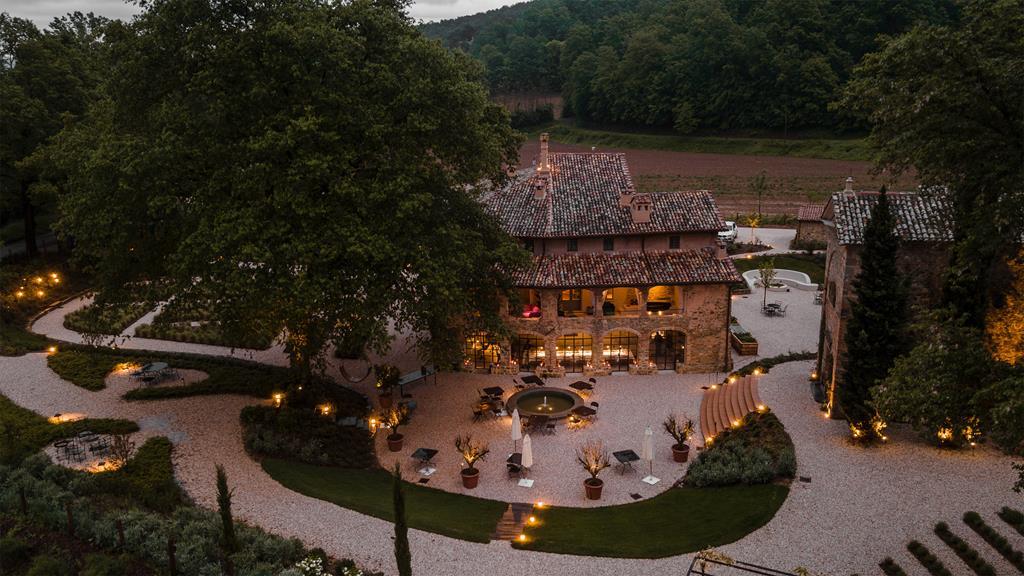 Vocabolo Moscatelli (photo: Victor Fitz)
Still, what truly defines this retreat is a sense of disconnection. Breakfast is served whenever you like, rooms are free of televisions and confusing tech, and wifi is available only under the playful network name “Remember to unplug” with the password “ipromise”.
“The goal is to feel free, to find yourself again and to search for a lost sense of normal,” says Lütjens with a smile. Staff don’t wear uniforms; the idea is to blur boundaries and make guests feel truly at home. You arrive as clients and leave as friends – and that spirit of community is even stronger on summer Tuesdays, when the long, pergola-covered table fills for communal dinners under cascades of white wisteria, or in autumn, when the feasts move into the loggia. A circular bar invites conversation, and evenings often end gathered around the fire, turning strangers into kindred spirits.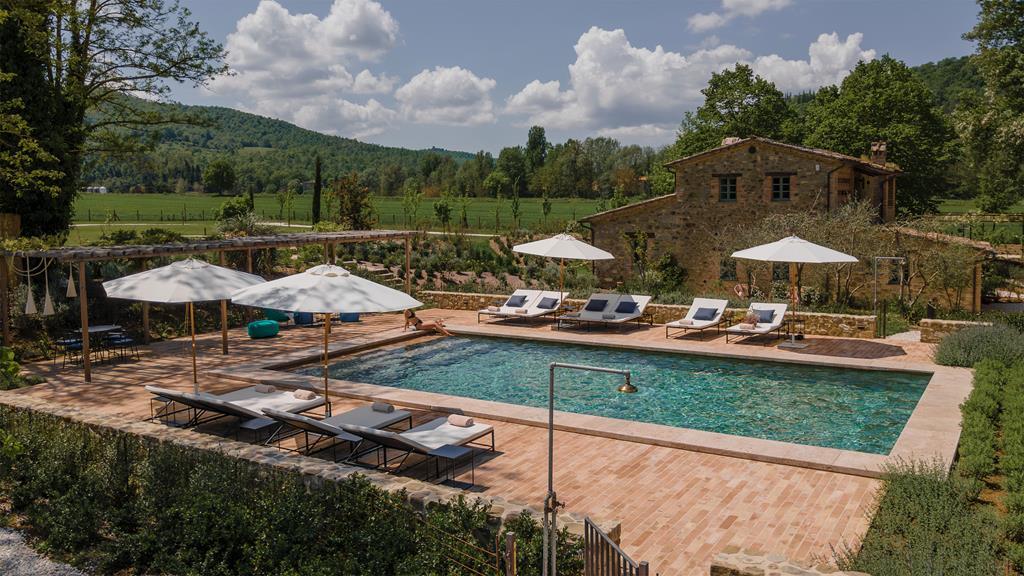 Vocabolo Moscatelli (photo: Victor Fitz)
Beyond the property, Umbria continues its dialogue between sacred and secular. Just 20 minutes away lies the medieval village of Montone, where the Taverna del Verziere occupies the crypt of the ancient Church of San Fedele. And in Orvieto, one of the region’s most celebrated restaurants, Ristorante Coro, is set among the vaults of the former Church of San Giuseppe. The atmosphere is hushed, almost ascetic, as each dish emerges slowly, shaped by the season, the land and the patience to listen to ingredients themselves.
In Good Company
Panicale, recognised as an I Borghi più belli d’Italia (“one of the most beautiful villages of Italy”, and the name of a non-profit association of historical hamlets), sits quietly above Lake Trasimeno, where it remains untouched by mass tourism. From here, Perugia, Assisi, Montefalco and Gubbio are all within easy reach, but the village itself is a jewel of medieval streets, hidden corners and artistic treasures, including the Church of San Sebastiano, home to an angel fresco sometimes attributed to Raphael. 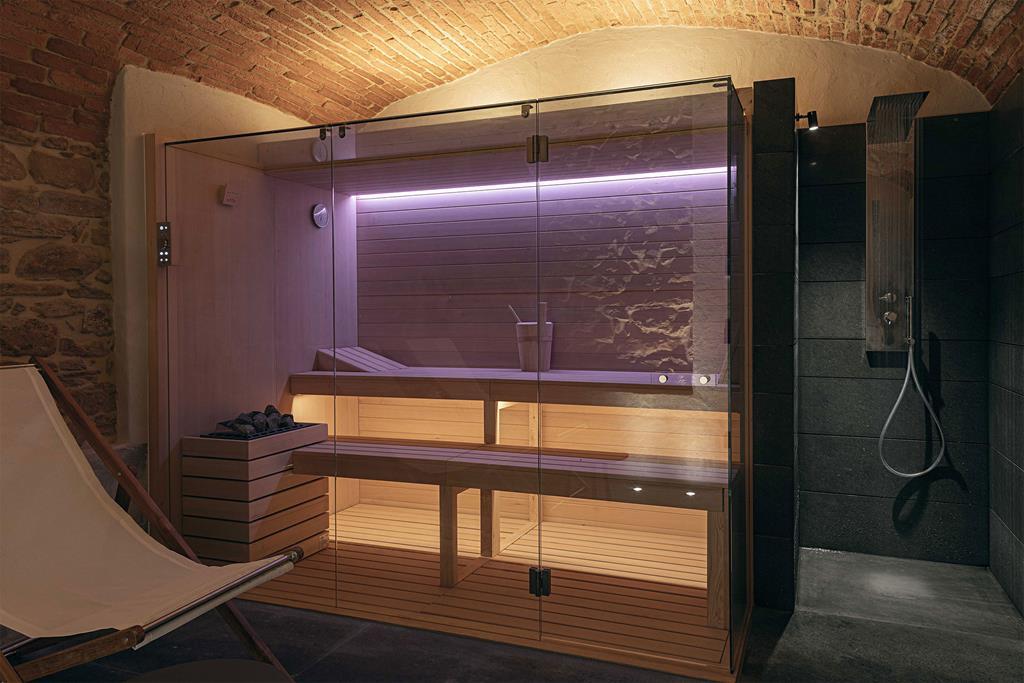 Rastrello (photo: Mattia Aquila)
Nestled within these ancient walls is, a boutique hotel in a 14th-century palazzo restored by Pellizzari Studio and owned by Christiane Wassmann and her husband. The name (rastrello means “rake”) is emblematic: each autumn, locals take their rakes to harvest the olives, a ritual of unity, labour and renewal. Christiane herself is an olive-oil sommelier, and her extra-virgin olive oil has won multiple gold medals. Guests can explore its flavours in tastings, in the dishes at the Cucina & Giardino restaurant – one of Umbria’s culinary highlights – or through treatments in the wellness area, including the Umbrian Bliss Journey, which harnesses the oil’s natural properties.
Service at Rastrello is informal and especially kind, reflecting the hotel’s ethos of hospitality rooted in community and sustainability. A certified B Corp, the property practises what it preaches, with circular gardening, homemade cocktail infusions and support for local artists and initiatives. Recent additions include the Garden Annex, adding seven rooms for a total of 16, a small outdoor pool and an acoustically designed meditation room aimed at creating the ultimate serene environment. Every detail is designed to amplify a sense of calm – perfect for those seeking modern luxury that is not defined by opulence, but by beauty, silence and reflection.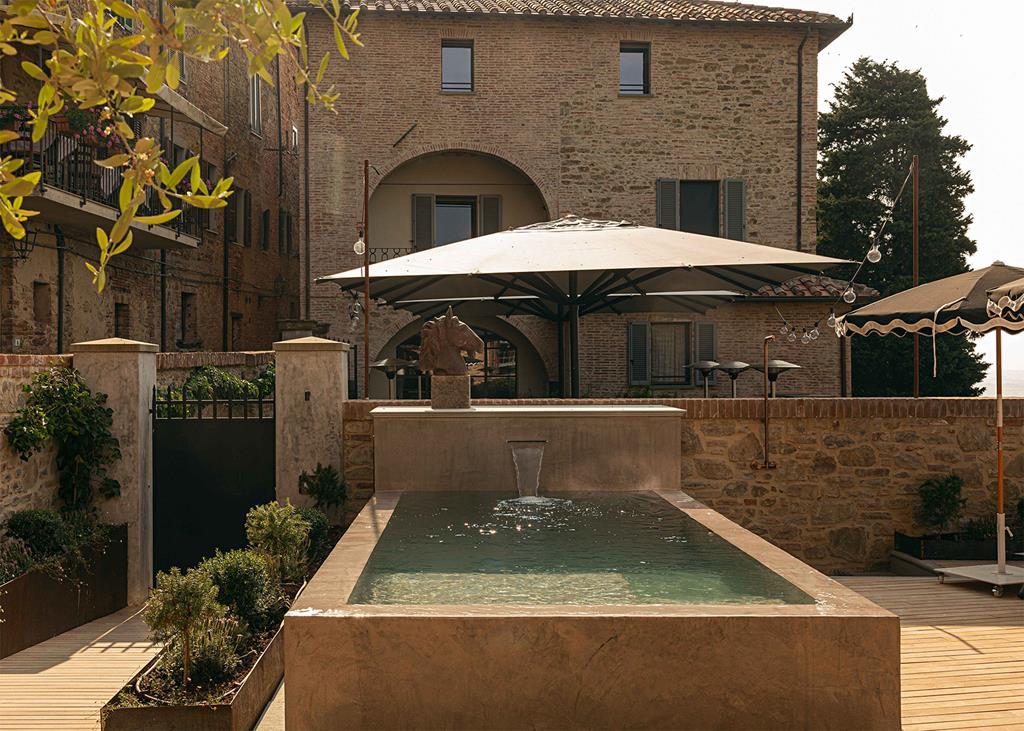 Rastrello (photo: Mattia Aquila)