The Man of the Hour
Affectionately dubbed the “Picasso of watchmaking”, the late Swiss designer Gérald Genta’s landmark 1972 concept for the game-changing Royal Oak was just the start of a prolific career that set the tone for horology in the late 20th century. Today, 15 years since his passing, his work is still key to understanding the world of watches now – and where it’s going.

Gérald Genta was one of the most colourful and provocative figures ever to grace the watch industry. Simultaneously fanciful, serious, artistic and enigmatic, he was both a prolific designer in high demand by established brands and a self-made entrepreneur. He was a figure who was revered, feared, at times derided by peers, and, finally, posthumously worshipped. But most of all, he inspired almost everyone. “He changed the way we think about watches – proving that geometry and emotion could coexist, that proportion could carry feeling,” Octavio Garcia, head designer at Audemars Piguet from 2003 to 2015, explains today. “For me, that’s the real legacy: the belief that design can be both disciplined and alive.”
Born in 1931 to an Italo-Swiss family in Geneva, Genta earned a diploma certifying him as a goldsmith and jeweller. In 1954, Universal Genève first recognised his talent as so much more than the sum of those parts, recruiting the young man, at the age of 23, to design what would become one of the historic brand’s greatest success stories: the SAS Polerouter.
Though Genta was constantly painting all kinds of watches, it was the next phase of his career that would become his eternal claim to fame. It began with his refreshed design for the Omega Constellation, in particular the 1964 evolution that gave it an integrated, seamless look uniting the case and bracelet, known by Omega buffs as the C-Model.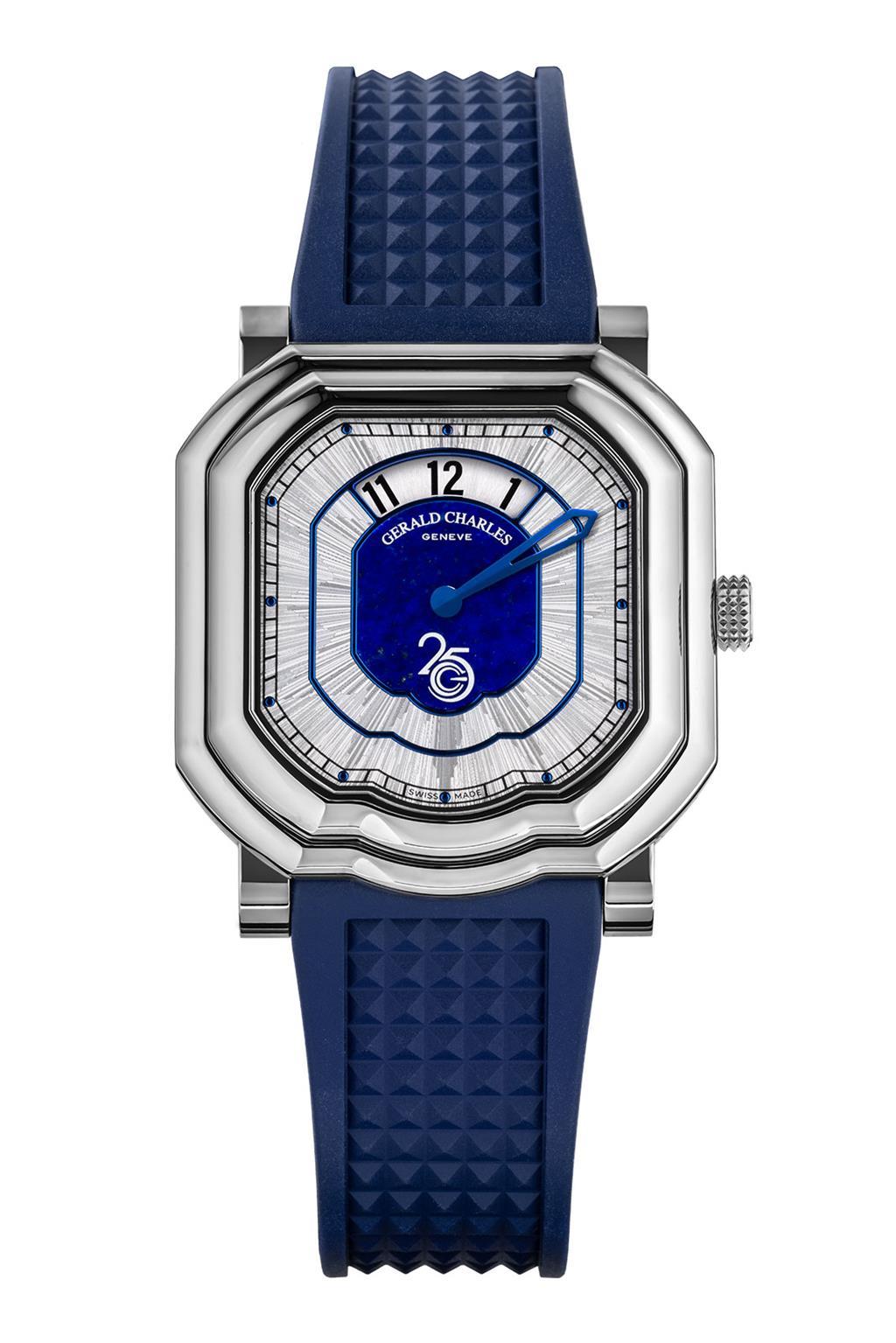 The Maestro GC39 25th Anniversary Edition, a rarefied evolution of a beloved 2005 Gerald Charles model with a vibrant lapis lazuli dial
In 1972, the progression of his historic designs turned to the Audemars Piguet Royal Oak, the industry’s first luxury sports watch, famously audacious as the first modern timepiece to carry an haute horlogerie price tag for a stainless-steel watch. A bold move, as it was a fraught time period for the Swiss watch industry: the introduction of quartz, a looming oil crisis and fluctuating exchange rates had all contributed to instability in sales and production. And for the Swiss watch world, built on tradition and precision, change was never easy. Miraculously, it was perfect timing for Genta’s Royal Oak.
Under contract to Audemars Piguet for more than 20 years, Genta personally sketched each new watch and collection. The Royal Oak was specifically born from the need for a new watch to be presented to the Italian distributor, Carlo de Marchi, a premier taste-making market in those days, at the 1971 Basel Fair. What was needed was a brand-new, all-purpose, unprecedented wristwatch reflecting a more contemporary lifestyle. Unfortunately, this was only communicated to Genta the night before the presentation. No matter: de Marchi loved his spontaneous idea.
“I didn’t officially meet Mr Genta until 2010, but by then, his influence was already deeply present in my work,” Garcia remembers. “When we finally spoke, I asked him about [the Royal Oak’s] hands and indexes – why he gave them such soft contours against such a sharp, architectural case. He told me he wanted them to feel protective, almost maternal, to counter the brutality of the design.”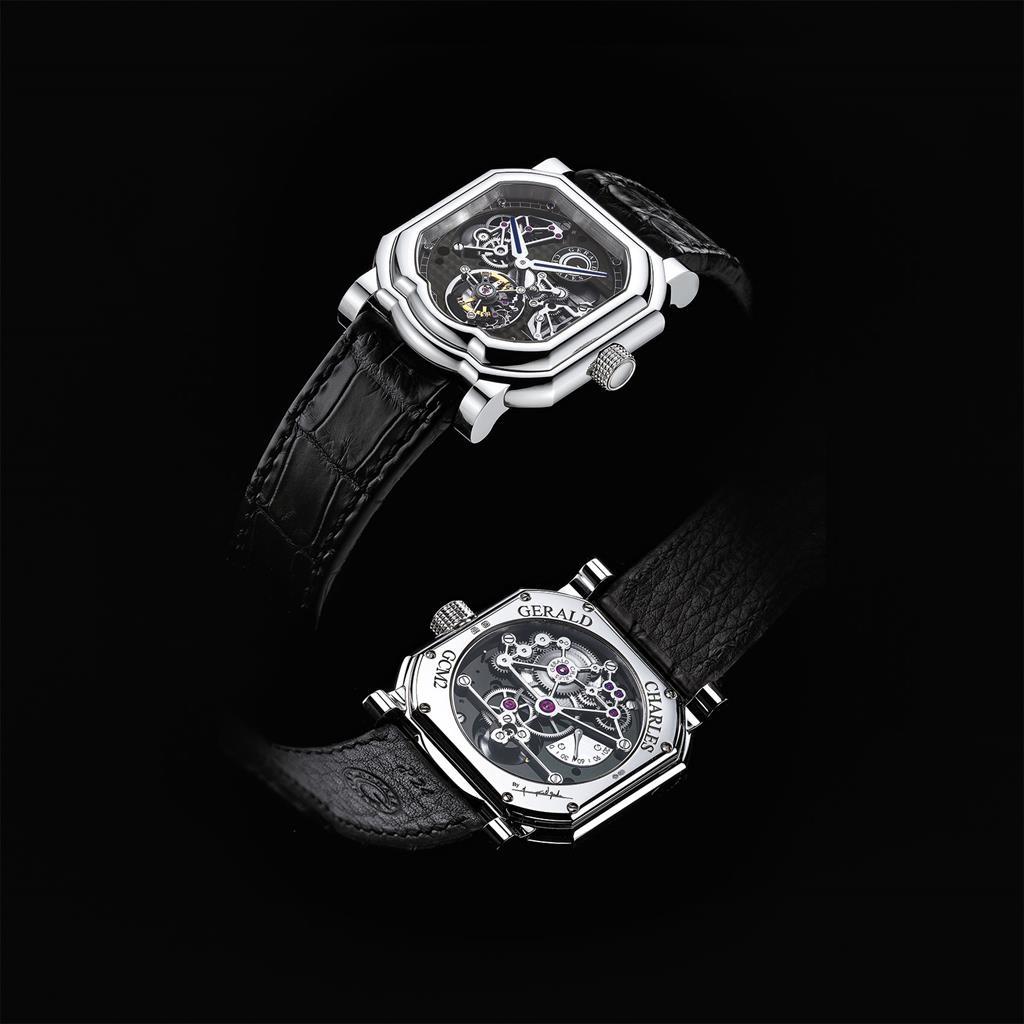 The Gérald Charles Maestro Flying Tourbillon
The Royal Oak changed the watch industry’s sense of luxury timepieces. This shift not only caused every other major manufacturer to follow suit with its own sports watches with integrated bracelets in stainless steel – many of which were also designed by Genta – but also helped to usher in the modern, more casual feel for luxury watches with which we are now familiar. These especially include the Patek Philippe Nautilus and the IWC Ingenieur, both unveiled in 1976. It has been widely reported that, like the Royal Oak, Genta sketched the Nautilus (also inspired by the maritime world and named for Captain Nemo’s submarine) during an edition of the Basel Fair in mere minutes – but this time on a paper napkin in a restaurant.
For Bulgari, which at the time was really a jewellery brand riffing on Greco-Roman renaissance inspiration, Genta designed 1977’s Bulgari Bulgari, a surprisingly sober piece with a lasting impact on the Roman house. For Japanese powerhouse Seiko, he created the unusually angular Credor Locomotive of 1979. In 2024, Seiko issued a tribute piece in honour of the 50th anniversary of its sub-brand Credor, developed in collaboration with the Gérald Genta Heritage Association, which is run by Genta’s widow, Evelyne. Evelyne today says of the Locomotive, “He [Gérald] loved it. It was the only [watch] outside of his own brand that he named.” According to Seiko, the name “embodied Genta’s vision of propelling Credor – and Seiko – into the future”.
In 1969, Genta founded a company – this time under his own name – that was less about designing for other brands and more about having a space for his imagination. Naturally, his own brand produced some visual spectacles that often included unusual combinations of complications. One of the most significant of these was the Retro, a watch combining a jump hour with a retrograde minute hand, an eye-catching feature thanks to its lightning-fast return to zero upon hitting the 60-minute mark. The model still fascinates today, with the second-hand market steadily hunting for the many variations made.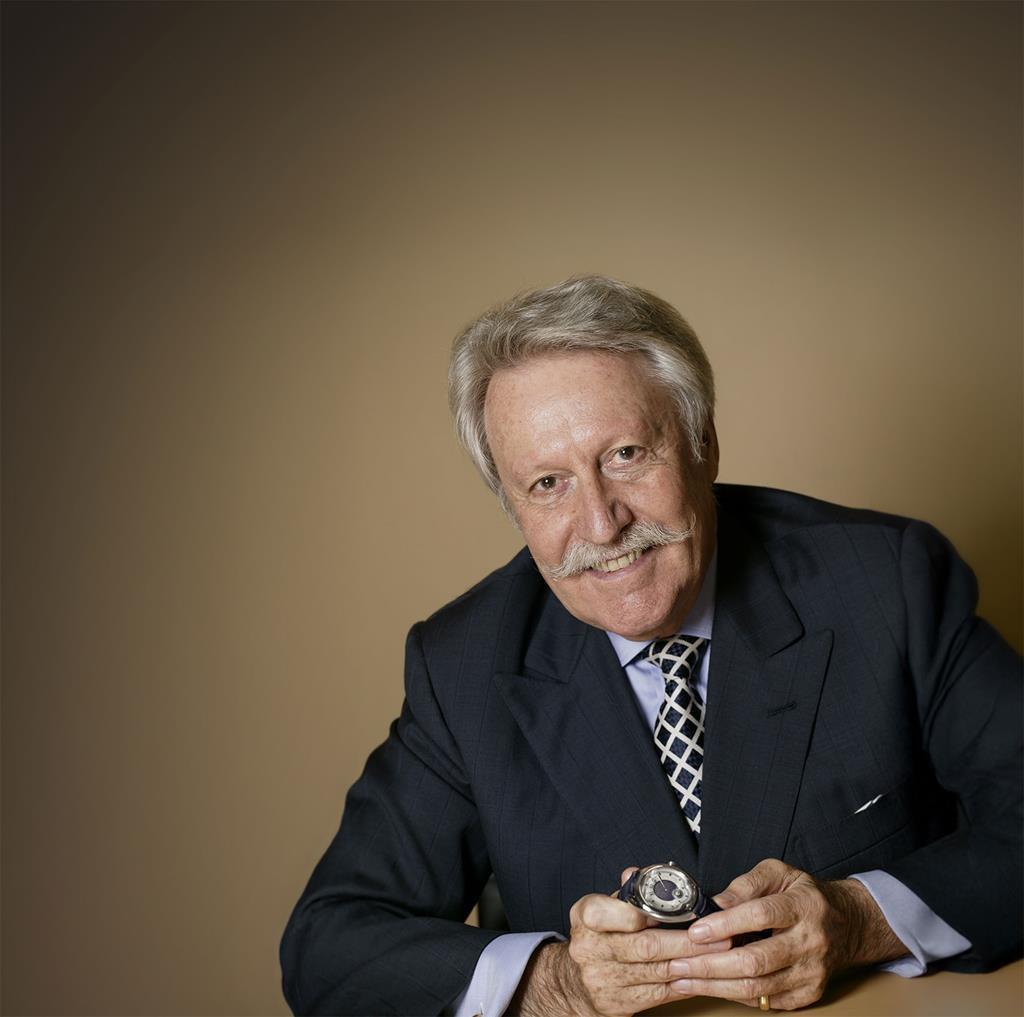 The late Gérald Genta
Another highly sought-after design was the Fantasy collection: a series of Retro models in which Disney characters like Mickey Mouse and Donald Duck point to the time with a retrograde arm, bat or golf club. This author even remembers hearing well-established watch-industry figures laughing about the characters’ use in the serious world of haute horlogerie during a Basel Fair in the 1990s, calling Genta an “enfant terrible” – arguably, a sort of backhanded compliment as the establishment perhaps somewhat feared his particular brand of creativity.
The Grande Sonnerie remains another of Genta’s famous 1990s designs, a perfect example of how design visually separated Genta’s watches in a radical way from the “normal” faces that established watch brands were releasing; by this point in the mechanical renaissance, the focus was squarely on highly complicated movements without much attention given to design.
“What struck me most [upon meeting Genta] was his clarity. He spoke about proportion, balance and the emotional logic of design as if the ideas were new,” Garcia remembers. “He had this uncanny ability to find geometry in everyday life, to see form and rhythm in objects most of us overlook … Every line had intention.”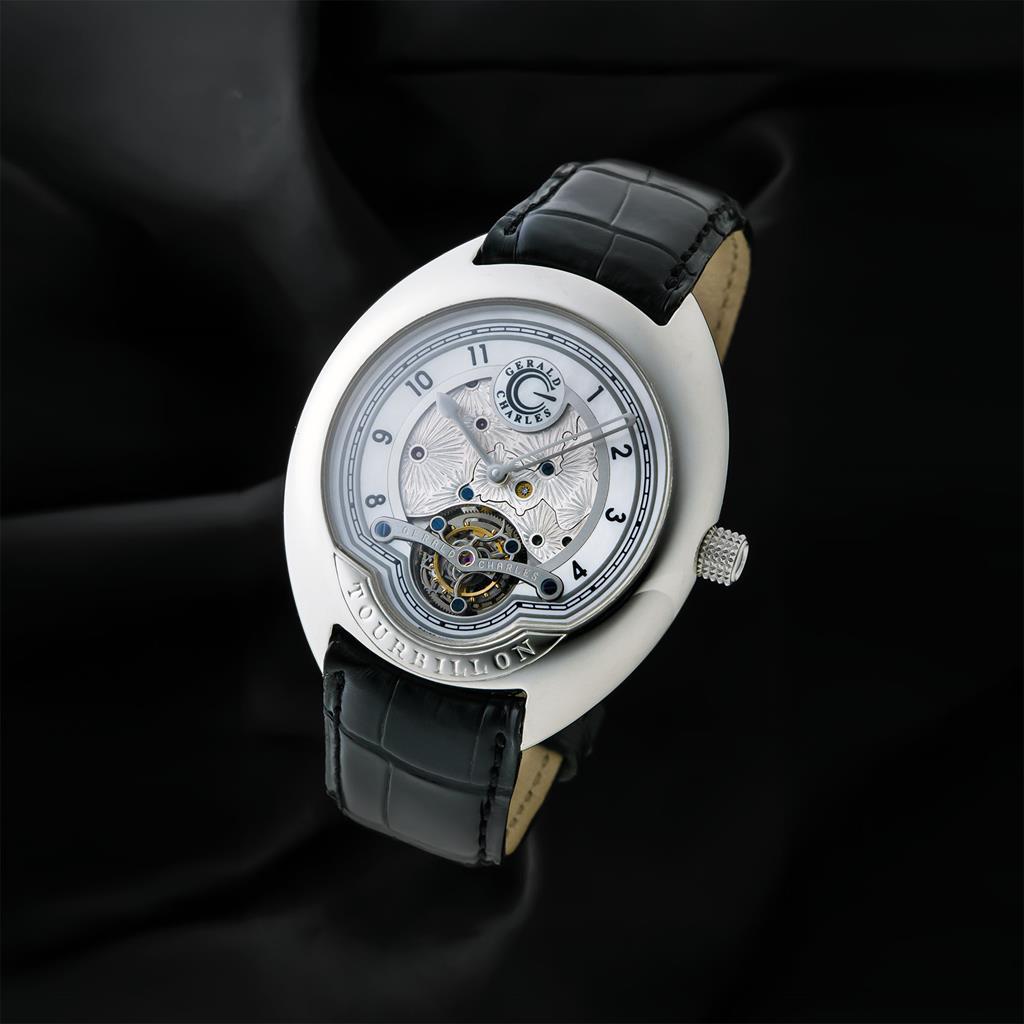 Gerald Charles Maestro 9.0 Tourbillon
In 1996, Genta sold his eponymous brand to Singapore-based retailer The Hour Glass. However, financial difficulties forced THG to sell it in 2000 to one of Genta’s former clients, Bulgari, which began retiring his name from the dials in 2010, laying the basis for Bulgari’s creative high watchmaking as we know it today, with its distinctive shapes and myriad high complications.
In 2023, Bulgari’s parent company, LVMH, under Louis Vuitton’s director of watches, Jean Arnault, revived the Gérald Genta brand with Evelyne’s blessing, drawing from the archives and issuing very limited new editions. The charge is being led by Enrico Barbasini and Michel Navas, heads of La Fabrique du Temps, Louis Vuitton’s Geneva-based high-end movement manufactory. They take this task very seriously since both had previously worked for Genta in the early 1990s in the high complications department; this marks a sort of homecoming for the genial watchmakers, and the pair very excitedly discusses the project at every opportunity with evident joy. Key is that Louis Vuitton will not be recreating Genta’s watches but evolving them as they feel the master himself would have, building on his legacy without trying to replace it, aiming to honour and extend his profound influence.
The Gentissima Oursin came first in three 36.5mm variations with cases crafted in bead-blasted titanium and adorned with 223 beads, studs or diamonds. Each appendage, made in a contrasting material to the sturdy and light titanium, is painstakingly, individually screwed into the case. “We wanted to do the case better [than the original],” says Navas, pointing to the fact that the original 1994 case was monobloc metal, while this new version has a very complicated bombé shape. “Respect to the DNA of Gérald Genta, but we wanted to do more.”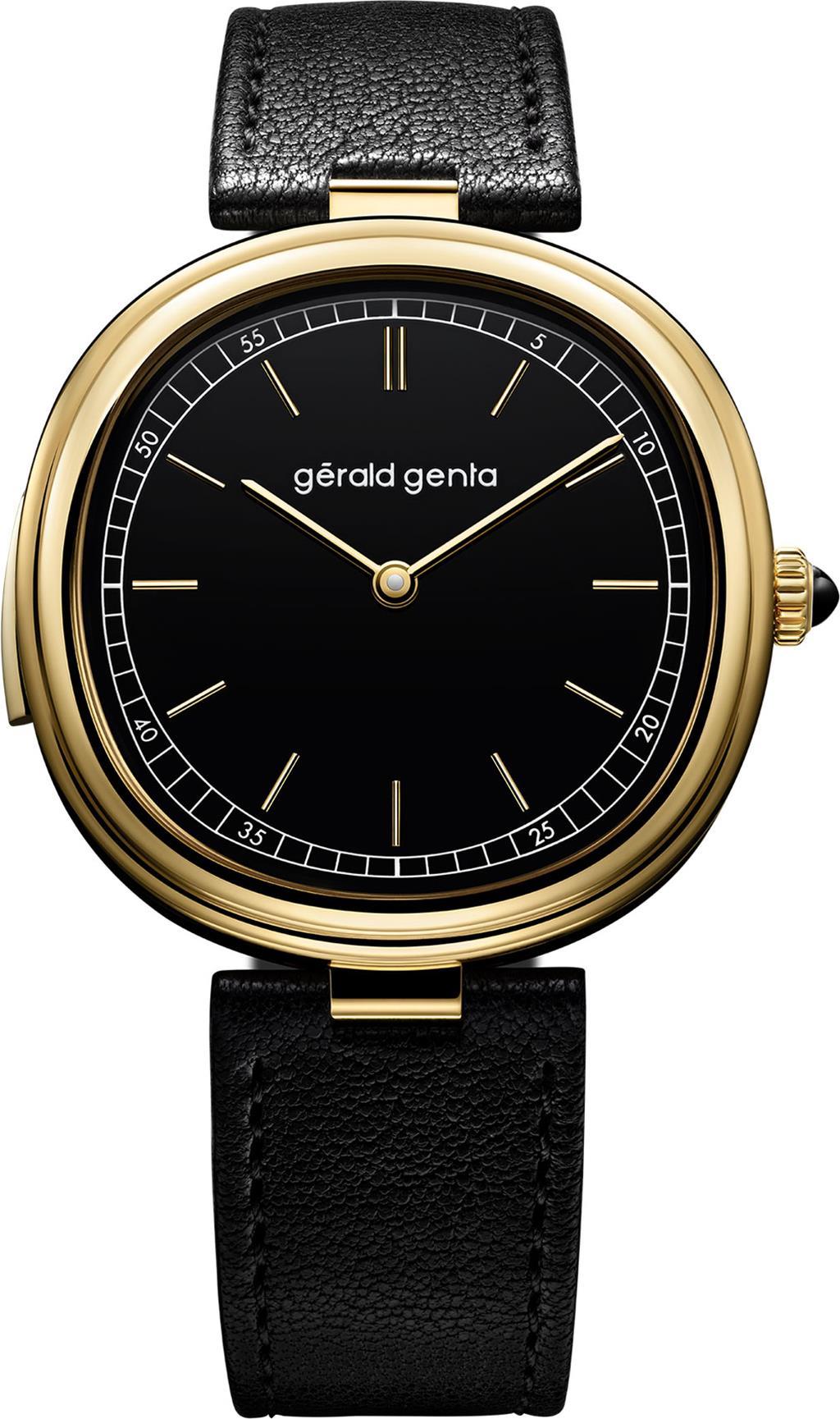 The 40mm Minute Repeater, a limited-edition 2025 release by Gérald Genta’s eponymous brand
The most recent addition to the limited contemporary collection is the Minute Repeater, which blends modern watchmaking techniques and ideals with Genta’s original design elements. This incredibly wearable 40 x 9.6mm timepiece comes in a softly cushion-shaped yellow-gold case and is outfitted with a noteworthy onyx dial, celebrating Genta’s love of stone dials. Despite its mechanical complexity and the vintage-feeling gold case, the chimes’ acoustics are magnificent.
In 2000, Gerald Charles – derived from Genta’s first and middle names – was the final brand to be established by the watch industry’s most famous designer. Genta sold Gerald Charles to the Ziviani family in 2003, but continued to serve as its head designer until he passed away in 2011. Up until recent years, Gerald Charles focused on low-volume, high-end, bespoke timepieces. Today, Gerald Charles, now under the guidance of second-generation CEO Federico Ziviani, produces serial timepieces housed in the Maestro case shape that Genta created in 2005, which has since been reworked by Garcia, who is now art director at Gerald Charles. “When I think about carrying his legacy, it’s not about trying to design like him,” Garcia explains. “It’s about understanding the reasoning behind his choices – how he balanced logic with emotion, structure with softness. That’s what I try to keep alive, whether it was at Audemars Piguet back then or now at Gerald Charles.”
Fifteen years after his passing at the age of 80, this prolific designer very much feels present in the modern-day watch industry. And why shouldn’t he? His creations are still everywhere.
All images © Gérald Genta