Building a Legacy
Once humble, utilitarian farm structures, the modern winery has become a playground for the avant-garde fancies of leading-edge architects.

It’s not immediately clear when the alignment between architecture and wine began. Viticulture has always had an intricate relationship with art and artists, perhaps because of the enduring – if not always healthy – correlation between drinking and creativity. After the young Baron Philippe de Rothschild took charge at the legendary Château Mouton Rothschild (among the most famous of all Bordeaux vineyards) in 1922, one of his earliest innovations was to invite artists to design wine labels. Over the years, contributors to the Château’s bottle-borne gallery have included Georges Braque, Salvador Dalí, Joan Miró, Francis Bacon, Lucian Freud, Marc Chagall, Henry Moore and Andy Warhol – an assemblage worthy of a world-class national gallery.
So at what point did the “mother of all arts” enter the frame? Today, some of the world’s most preeminent wineries are also architectural masterpieces, revered for their dramatic and innovative forms as much as for the products that emerge from their cellars. To answer this question, one must go back to the days when the vineyard became a destination in its own right. In part, this is a Californian innovation, dating back to the early 1980s. Vineyards have never shied away from receiving visitors, let alone visitors in search of wine to buy, but the origins of what we now know as wine tourism – or oenotourism – originated in regions like Napa Valley in the 1970s and 1980s. The establishment of the Napa Valley Grapegrowers association in 1975 gave common cause to the region’s many small vineyards, as well as promoting the idea of a prescribed tasting route through the area.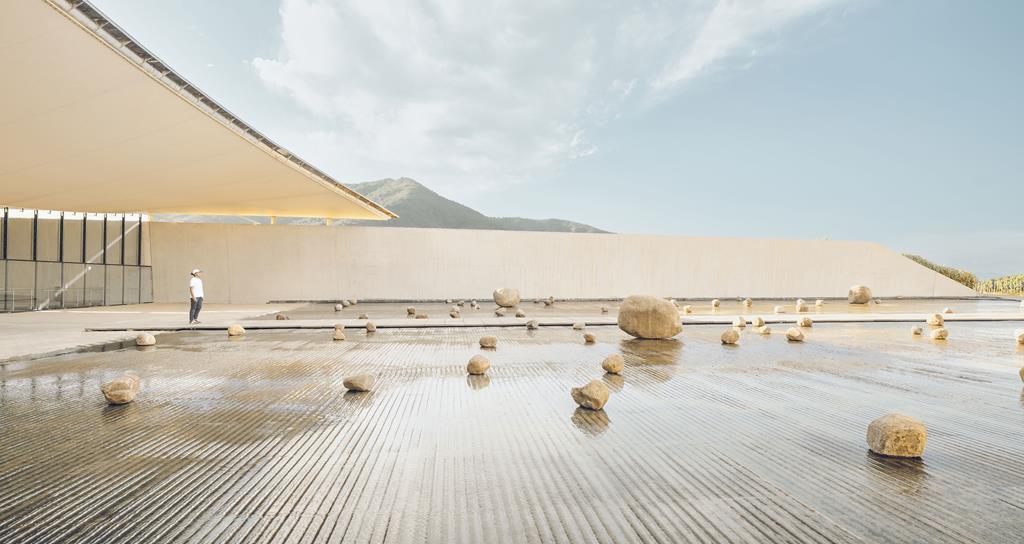 VIK Winery (© Vik Wine)
The following year saw the so-called “Judgment of Paris”, a high-profile blind tasting held in France. In a result that could have been scripted in Hollywood, the plucky upstarts from Napa triumphed over many long-established French vineyards. It gave the region a huge boost, and investment flooded in. Creating architecture and making wine both require patience. Ironically, it was a Frenchman, Christian Moueix, who gave California its head start in viticultural architecture. Moueix acquired a share in the Napanook vineyard estate in 1982, establishing the Dominus Estate winery. It was a decade or so before replanting and careful cultivation achieved the quality levels he desired, and to accompany the vineyard’s launch to the world, Moueix commissioned a new building. He chose a small Swiss firm of architects founded by Jacques Herzog and Pierre de Meuron. The resulting Dominus Estate, completed in 1997, was Herzog & de Meuron’s first building in the US and marked the start of the studio’s ascent to global stardom.
There had been earlier local precedents, such as Michael Graves’s Clos Pegase Winery in Calistoga, opened in 1987. Graves was an ardent postmodernist, however, and though striking, his complex drew on the classical forms of Tuscan palazzos and barns, not the emerging language of freshly revitalised modernism. In contrast, Dominus is a long, low building that uses gabion walls – rocks contained within steel baskets – to tie itself into the surrounding landscape. Unashamedly modernist, it represented a step change from the folksy vernacular of wineries composed of traditional-style barns and quotidian agricultural sheds, all doing double duty as stores, showrooms and visitor centres.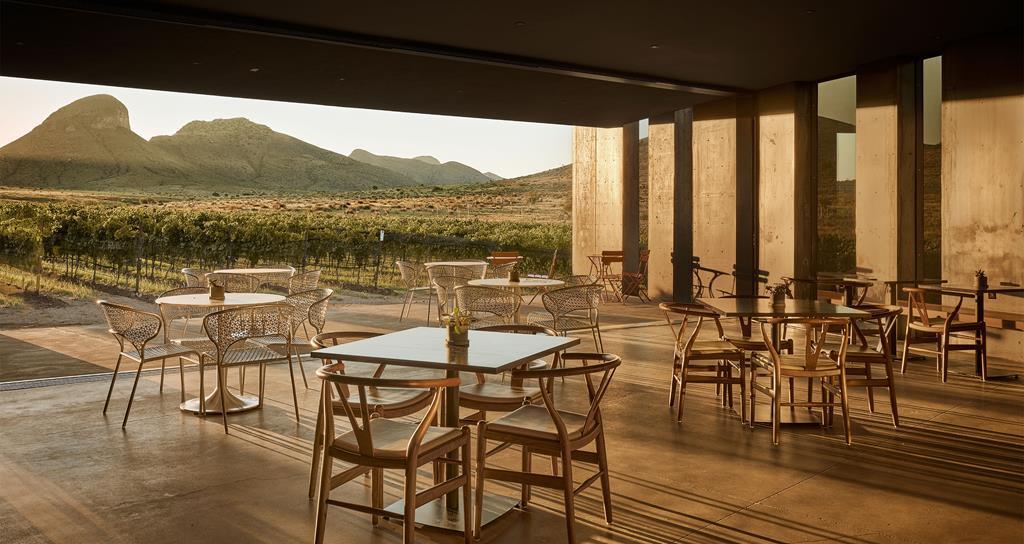 Los Milics Vineyards (Photo: Dan Ryan Studio)
Before long, there were many imitators, small and large. Tasting rooms, restaurants, shops (or cellar doors), viewing platforms above the rows of vines and even smart hotels joined the list of essential winery functions. Such elaborate and open briefs were blank slates for adventurous architects, especially given the absence of context save for rolling fields of vines. Other wineries soon followed suit. In 2001, Santiago Calatrava’s Bodegas Ysios Winery in Laguardia, the heart of Spain’s Rioja country, served up a rippling form that rose above the landscape, while Frank Gehry’s award-winning building for the Marqués de Riscal vineyard, just 15 minutes to the south, is a rare justification of that hyperbolic appellation “icon”. Allegedly inspired by the curled and crinkled foil removed before uncorking a bottle, it houses a hotel and restaurant surrounded by a complex of wine-focused structures old and new.
From here onwards, commissions cascaded towards big-name architects. You’ll find a winery in the portfolio of most Pritzker Prize winners, including Glenn Murcutt’s Lerida Estate Winery in New South Wales (2003), Álvaro Siza Vieira’s Quinta do Portal winery in Portugal (2010), Christian de Portzamparc’s 2011 Château Cheval Blanc in Saint-Émilion, France, and Jean Nouvel’s Château La Dominique (2014), also in Saint-Émilion. Wineries feature in the oeuvre of Norman Foster, Zaha Hadid, Richard Rogers, Renzo Piano, Tadao Ando and even Oscar Niemeyer. The last four are all represented at Château La Coste, a remarkable complex of art and architecture in Provence, France. Owned by Irish property developer Paddy McKillen, the 200ha estate also incorporates sculpture, pavilions and installations by Gehry, Kengo Kuma, Jean Nouvel, Richard Serra, Conrad Shawcross, Ai Weiwei and Tracey Emin, making it a must-visit destination for cultured oenophiles.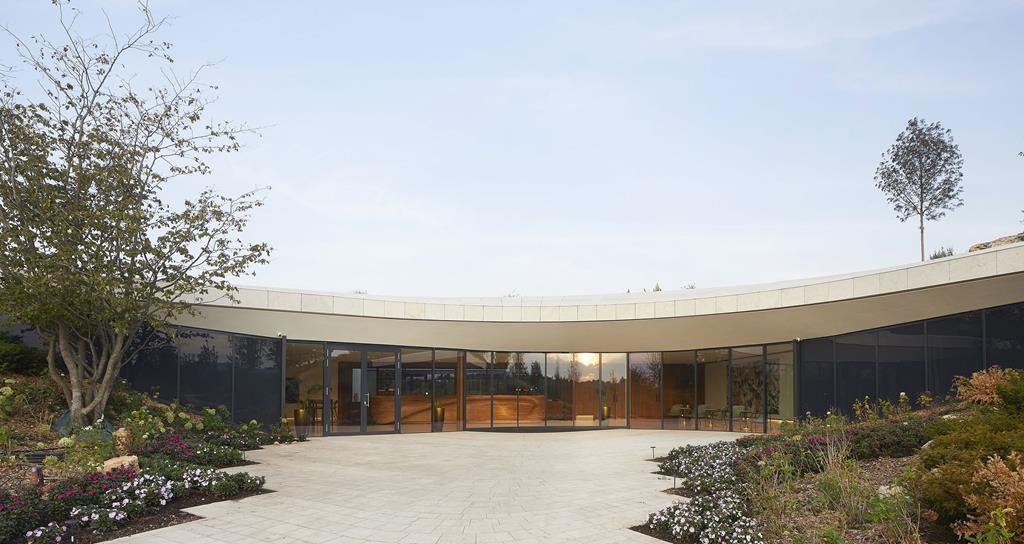 Sauska Tokaj Winery, Hungary (Photo: Hufton+Crow)
The 2010s and 2020s saw a resurgence on a smaller scale with less overtly iconic winery buildings, enabling even large practices to experiment. For a major global operation like Foster + Partners, the winery is a modest project yet one with the kudos of a gallery or private residence. The studio’s designs for Le Dôme winery in France (2021) and the Legacy of Bodegas Faustino, a major extension for the eponymous winery in Spain (2024), are a case in point, with their relatively compact dimensions allowing for richly detailed experiments in material, form and structure that wouldn’t fly in, say, a major airport terminal or stadium.
Winery design combines many aspects of the architect’s toolbox; they are buildings where contemplative vistas go hand in hand with bold forms and materials. A winery is a working structure, housing not just the magic of fermentation, but the deeply symbolic storage and ageing of the wine itself, along with its bottling, sale and distribution. Here, the fruits of the surrounding landscape are gathered, processed and distributed: an ancient cycle of production that lends itself to being visible at every stage.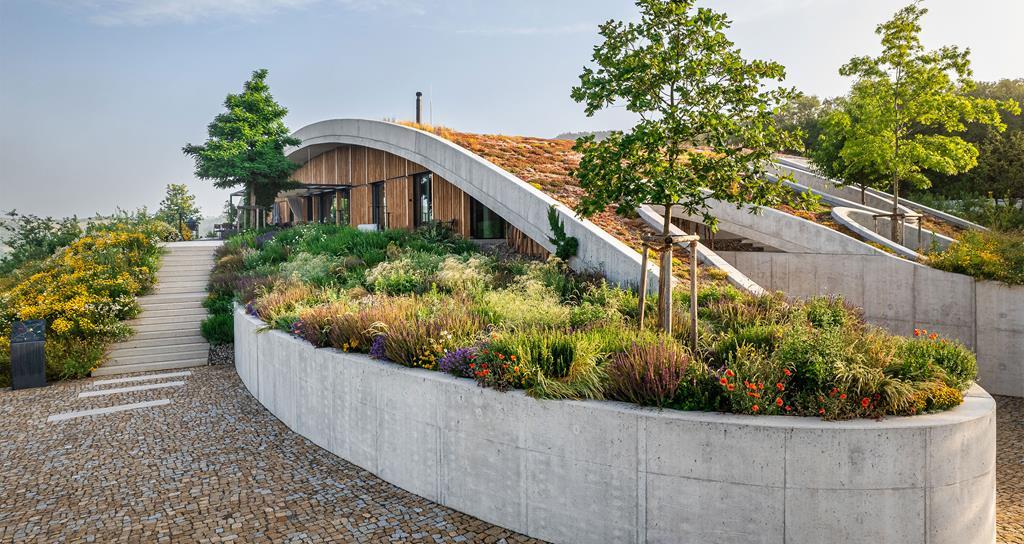 Gurdau Winery, Czech Republic (Photo: BoysPlayNice)
Some wineries are more avant-garde than others. Smiljan Radić’s VIK Winery in Millahue, Chile (2014) incorporates a sculptural heart by Marcela Correa, a water feature that sits atop the vat rooms, located underground to regulate the temperature of the winemaking process. Enclosed by walls, scattered with boulders and crisscrossed with paths, it creates a shimmering, abstract foil to the surrounding hills. In Arizona, Chen Suchart Studio’s tasting room for Los Milics Vineyards is treated like a piece of contemporary land art, an array of vertical steel monoliths that cloak the structure, marching across the vineyard like a Serra sculpture.
Japaz Guerra Arquitectos treated the entirety of the Bodega Anaia in Argentina as a response to the topography of the vineyard. A low-lying, angular concrete building, it appears folded into the hillside, with newly graded slopes serving to accentuate its form and shape the views. This desire to punctuate and infiltrate the soil itself – so crucial to the winemaking process – also helps define the extraordinary, citadel-like structure of BORD Architectural Studio’s Sauska Tokaj winery in Hungary (2024). Two vast interlocking discs sit atop a hill, tilted forward to view the vines, splayed out fan-like before them.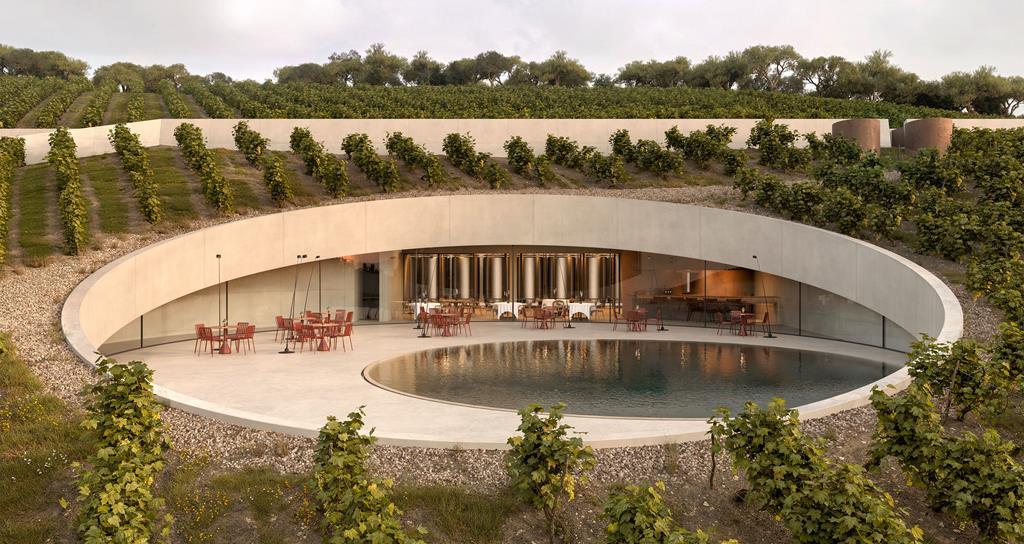 Ktima Aidipsos Winery, Greece (Photo: Studio Taf)
Similarly, the Gurdau Winery in the Czech Republic by Aleš Fiala (2022) aims to integrate structure with landscape, using organic concrete forms to create contours that weave their way through the vineyard. An even more dramatic counterpoint to the existing landscape was proposed by Fotis Zapantiotis Associated Architects for the Ktima Aidipsos winery in Greece. Featuring a viewpoint formed from a circular cutout and an access route that makes a slash in the hillside, the concept is both architecturally distinct and minimally invasive. In Victoria, Australia, Cera Stribley’s St Hubert’s winery serves as an artificial counterpoint to the landscape, sunk into the site beneath a curving green roof. Completed in 2019, the winery buildings also saw the refurbishment of the existing agricultural sheds, with refined additions that make them appear stark and graphic against the landscape.
The architecture of wine frequently demonstrates an intimate relationship with the land. Olson Kundig’s building for Martin’s Lane Winery in British Columbia, Canada (2017) exemplifies the practice’s adept handling of industry and nature, using the gravity of the slope to drive the winemaking process. Conceptual visions have gone even further. The proposed Vitis Navarra and Bodegas Dominio D’Echauz winery in Soria, Spain, by Fran Silvestre Arquitectos, is composed of biocomposite hempcrete blocks along with cork-based mortar. The aim is to create a laboratory-like space where rare grape varieties can be studied, preserved and brought back into use in the industry.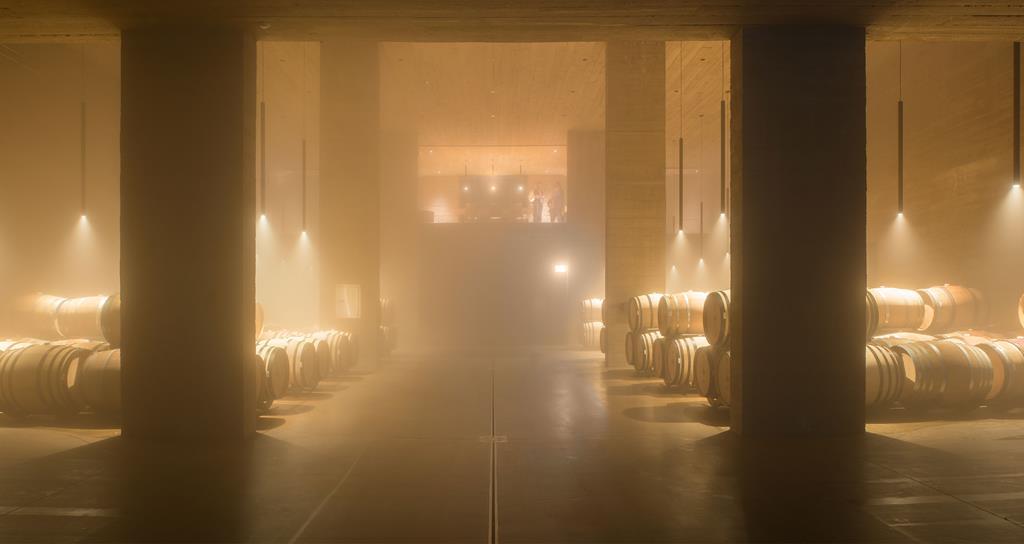 Martin’s Lane Winery, Canada (Photo: Nic Lehoux)
The winery is an architectural outlier, an atypical and rarefied typology with a unique relationship to its site. As a result, it has become a focal point for forward-thinking design, not just in terms of form and material, but in structure, layout and environmental performance. Viticulture is one of humanity’s most ancient industries, yet it still provides a source of great innovation and inspiration in every field.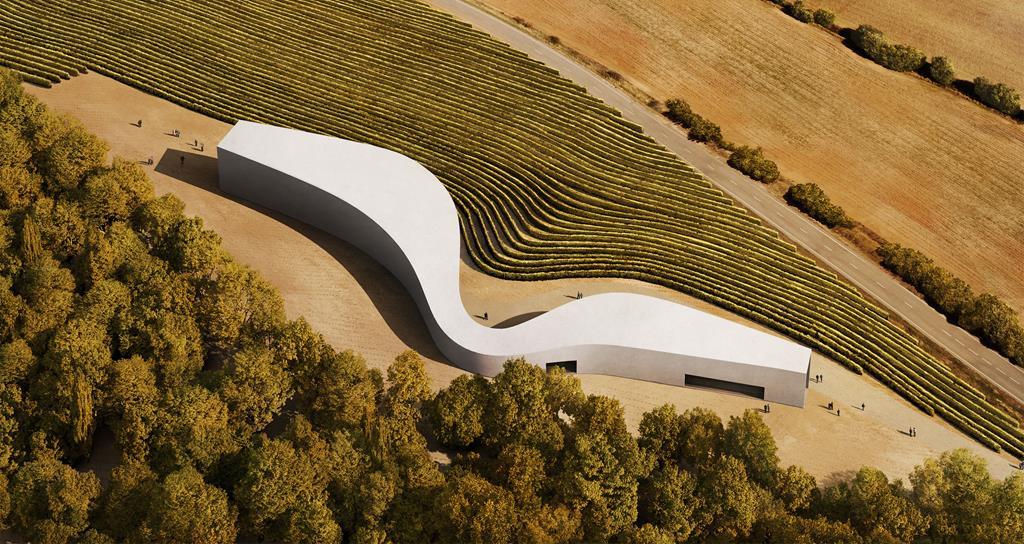 The proposed Vitis Navarra and Bodegas Dominio D’Echauz winery in Soria, Spain (Image: Agraph Studio)