Sailing A to Z
From the America’s Cup’s returning to the Mediterranean to the ground-breaking launch of Zero, a look at the state of sailing now.

In the summer of 2027, the oldest trophy in international sport heads for the Mediterranean. From 10 to 19 July, the 38th Louis Vuitton America’s Cup will be contested in the Bay of Naples, in the watchful shadow of Vesuvius – the first time in its 176-year history that the Cup has been held in Italy. The defender, Emirates Team New Zealand, will meet whichever challenger survives the qualifying gauntlet, since – as the old saying has it – “To win the America’s Cup, first you have to win the Louis Vuitton Cup.” And the field is the deepest in years: seven teams, with Britain’s Athena Racing as Challenger of Record alongside Italy’s Luna Rossa, Switzerland’s Tudor Team Alinghi, France’s La Roche-Posay Racing Team and late entries from Australia, under Tom Slingsby, and the United States, under Ken Read.
That gauntlet now has a shape – and a historic twist. The newly issued racing conditions open the Louis Vuitton Cup on 22 May 2027 with something never before seen: all seven AC75s racing together in fleet format, before the series settles into its familiar rhythm of one-on-one duels – three round robins through mid-June, a repêchage offering the bottom three challengers a last route into the semifinals, then a first-to-seven final in early July to decide who earns the right to face New Zealand. The defender will race in the early stages too, sharpening itself against the field, though its results won’t count towards the challenger standings.
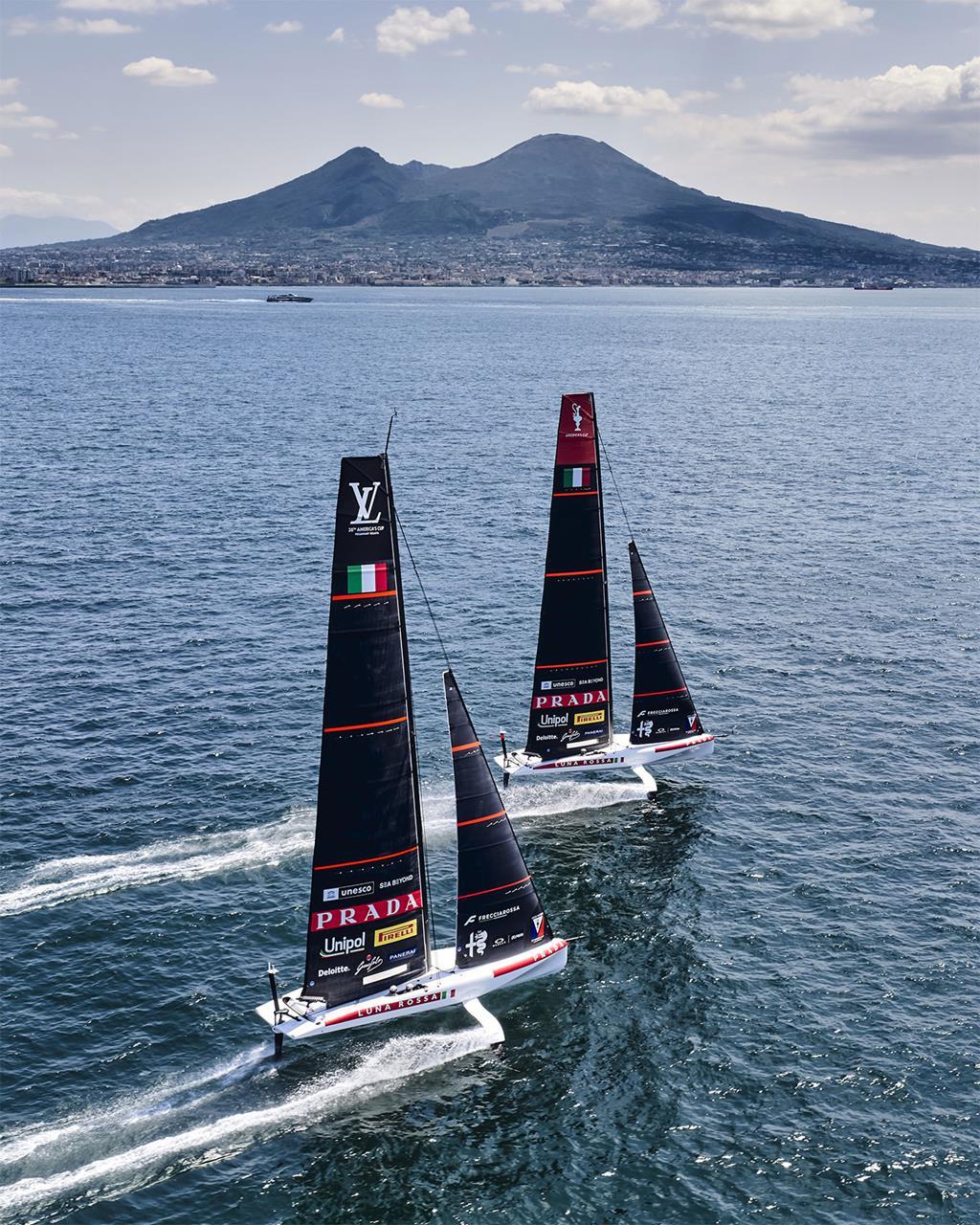 Luna Rossa’s AC40s train in the Bay of Naples, the host waters of the 2027 America’s Cup, with Vesuvius beyond (Image © Luna Rossa/Studio Borlenghi)
The Road to Naples is already under way. At the first preliminary regatta in Cagliari in May – fleet racing in one-design AC40 foilers capable of more than 40 knots, with several teams fielding second boats crewed by their women’s and youth squads – it was Luna Rossa, racing on home waters, who drew first blood, beating the defender in the winner-takes-all match-race final after a New Zealand starting error. The result carried no points towards Naples, but as a statement of intent from the Italian challenger, now skippered by three-time Cup winner Peter Burling, it could hardly have been clearer. The next reckoning comes on Cup waters themselves: from 24 to 27 September, the second preliminary regatta brings nine AC40s to the bay – including the debut of the American syndicate, training out of Pensacola under double Olympic champion Giles Scott – for a dress rehearsal before what promises to be a fiercely partisan crowd.
It’s worth reflecting on why sailing continues to exert such a hold on the public imagination. Perhaps it’s because no other pursuit offers quite the same combination of freedom and discipline, for both leisure and professional sailors alike: a machine propelled by nothing but wind, its entire grammar written in the angle between bow and breeze. A sailboat cannot point directly into the wind; everything else – speed, stability, the set of the sails, the time of arrival – flows from how that angle is read and played. There is a closeness with nature, unfettered by the noise of an engine, let alone the smell of petrol. It’s chess on the sea, a contest that is as mental as it is physical, and one that is never mastered, with more to learn about weather systems and anchorages as well as nuanced tactical judgements that win races. And because no boat sails itself, the sport remains, at heart, an exercise in camaraderie: communication and trust among family, friends or crew, with the elements supplying the drama.
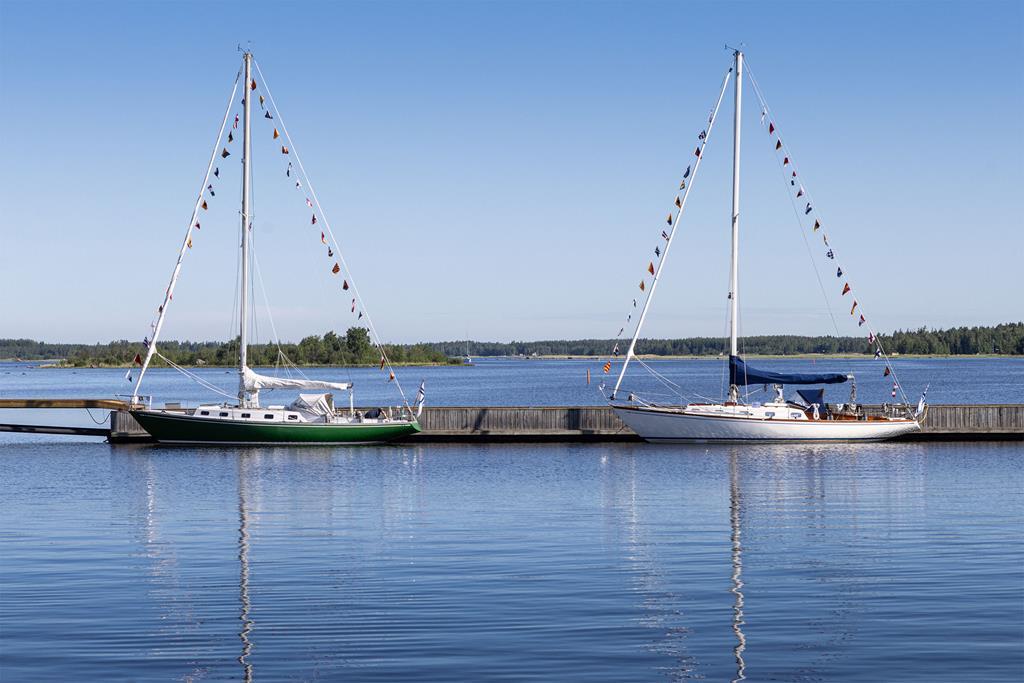 The original Swan 36 Tarantella, restored in honour of Nautor Swan’s 60th anniversary (Image: Eva-Stinka Kjellman)
Few institutions embody that culture like Nautor Swan, founded in 1966 by Pekka Koskenkylä in Pietarsaari, some 345 kilometres south of the Arctic Circle, and now marking its 60th anniversary – the first under the custodianship of Sanlorenzo – with a calendar of owners’ gatherings across Europe and the United States. The anniversary’s centrepiece is the first Swan 80, launched in June with a traditional Finnish ceremony at the yard and christened Elvi. She heads to the Cannes Yachting Festival in September for her world premiere before making her racing debut at the Rolex Swan Cup in Porto Cervo – led, rather movingly, by Tarantella, the very first Swan ever built, freshly refitted and returning as guest of honour.
First revealed in 2023, the 80 is the smallest yacht in the shipyard’s Maxi line yet unmistakably a true maxi, drawn to that magic threshold of the rulebook: a hull length of 23.99 metres, keeping her within the EU’s Recreational Craft Directive while delivering 42.6 tonnes of displacement and a 6.4m beam (the LOA including spars is 25.5m, though this doesn’t affect the racing threshold rule). The naval architecture is by Germán Frers, the yard’s partner of long standing, with exteriors by Lucio Micheletti and interiors by Misa Poggi – a thoroughly modern yacht conceived, above all, to be owner-friendly. The anniversary is hardly a backward glance: a Swan 73 and the Swan Alloy 44, the brand’s first aluminium supermaxi by Malcolm McKeon with interiors by Studio Liaigre, are already in the pipeline.
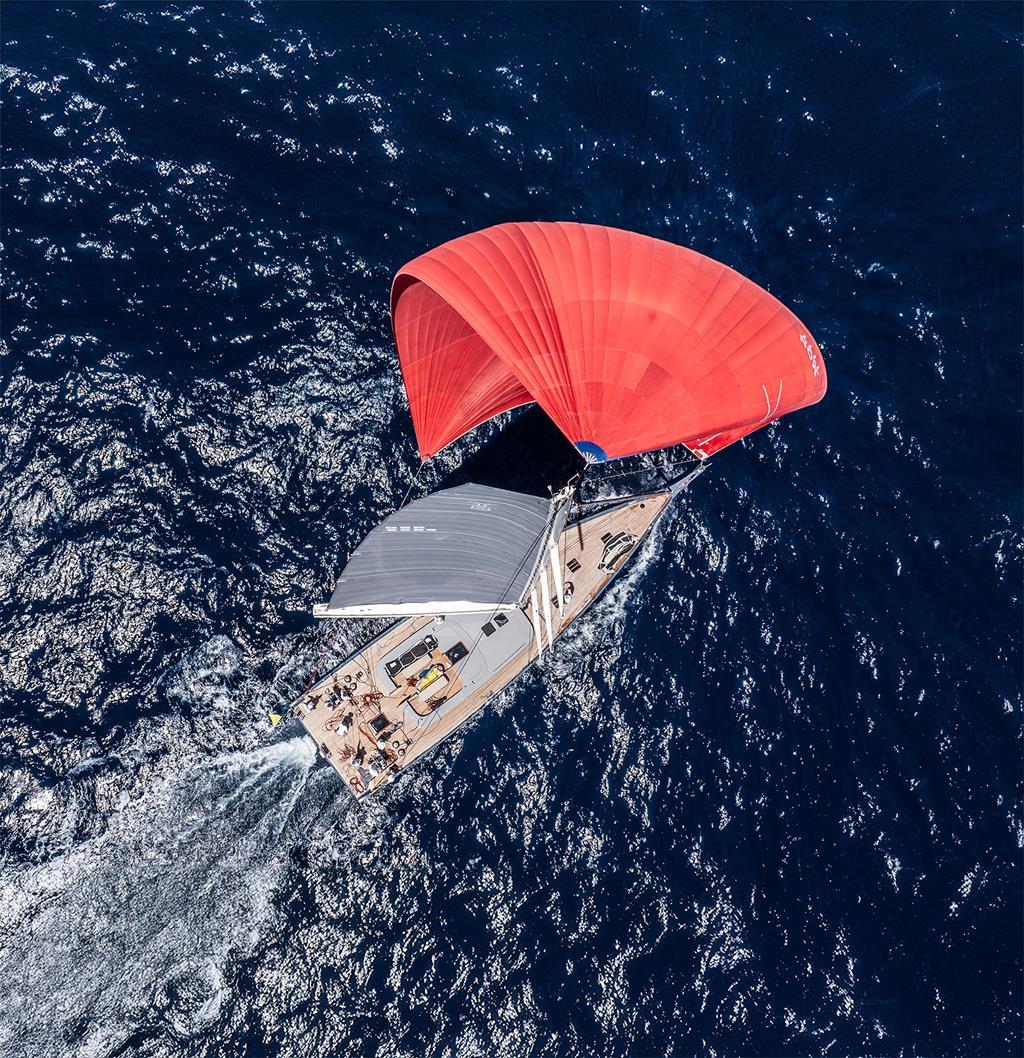 YYachts’ 24m Y8 Calabash under her unique tomato-red gennaker (Image © Sailing Energy/The Superyacht Club)
In Greifswald, on Germany’s Baltic coast, YYachts has its own milestone to toast: more than 50 carbon sailing yachts delivered in a single decade. Founder Michael Schmidt set out to build the boat he wanted to sail himself, guided by a single principle – keep it simple – and by an unusually catholic approach to design. Alongside such established names as Bill Tripp, Javier Jaudenes, Lorenzo Argento and Judel/Vrolijk, the yard has invited David Chipperfield, Norm Architects, David Thulstrup and Winch Design (none of whom had drawn a sailing yacht before) to rethink what living at sea might feel like. The first hybrid-powered 24m Y8 has now entered construction, and at June’s Superyacht Cup in Palma, the inaugural YYachts Cup gathered the fleet for a celebration of sailing, sportsmanship and the community the yard has built around it.
Finland’s Baltic Yachts, meanwhile, is scaling up a philosophy. Pink Gin Verde, the first hull of the Baltic 68 series, established what the yard calls “unplug-and-play” sailing: sustainable construction, advanced technology and genuinely easy operation. The new Baltic 80 Café Racer carries that lightweight ethos to full maxi proportions: again just under the 24m line, at a preliminary hull length of 23.98 metres, with a 6.4m beam, 29 tonnes of displacement and 11 tonnes of ballast. Javier Jaudenes has drawn the naval architecture and Design Unlimited the interior, envisioned as bold, bright and a little rebellious; hull number one, due for delivery in 2027, will carry a fully open, loft-style arrangement in which galley, dining and lounge flow into a single informal space.
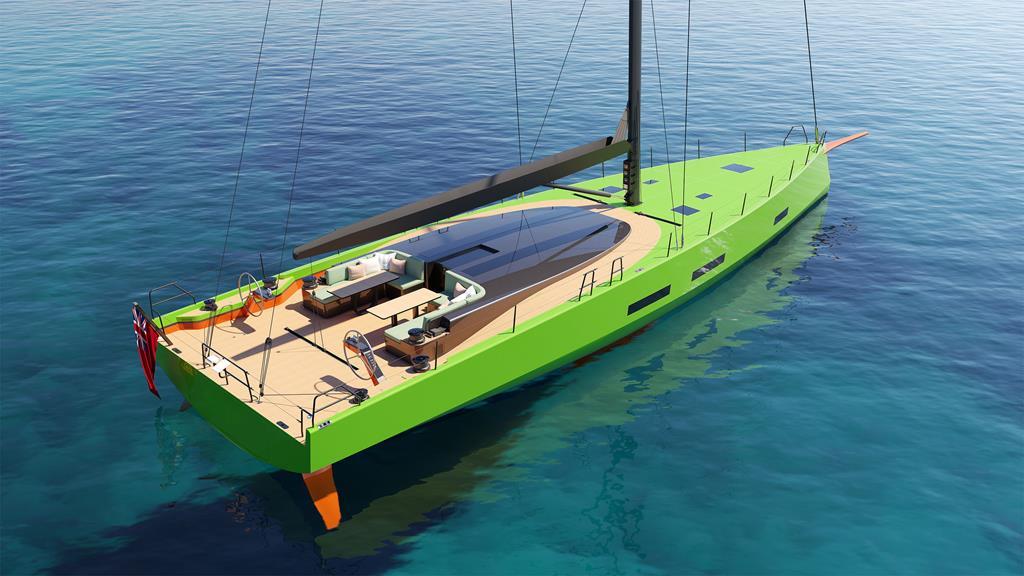 A first look at the forthcoming Baltic 80 Café Racer, due for delivery in 2027 (Image © Baltic)
Britain’s Oyster Yachts chose London for its moment in the calendar, gathering owners and the wider sailing community at St Katharine Docks from 29 April for its annual five-day Private View, with the 495, 565 Series II, 595 and 675 moored a stone’s throw from Tower Bridge. The talking point, though, was a yacht that does not yet exist: a new model in the 15m range – since unveiled as the Oyster 515 – which reimagines the aft deck so that, at anchor, it opens into something closer to a private beach club, without sacrificing the yard’s bluewater DNA. Chief executive Stefan Zimmermann Zschocke previewed the concept in conversation with strategic adviser Torsten Müller-Ötvös, the former Rolls-Royce chief executive now applying his experience-led vision of luxury to the water.
At the other end of the scale sits pure ambition. Royal Huisman’s Project SKY is conceived as the world’s tallest sloop: 81 metres of world-cruising sailing yacht crowned by the world’s tallest mast, to be built in-house at Rondal, beside the shipyard’s base in Vollenhove. Malcolm McKeon Yacht Design is responsible for the demanding naval architecture and the strikingly contemporary exterior, Winch Design for an interior that promises elegance with vibrancy. Her air draft of 93 metres matches the Statue of Liberty from ground to torch, and her makers claim she will sail faster than the wind – and faster than any motor yacht her size. Such superlatives take time: delivery would come in spring 2030 at the earliest.
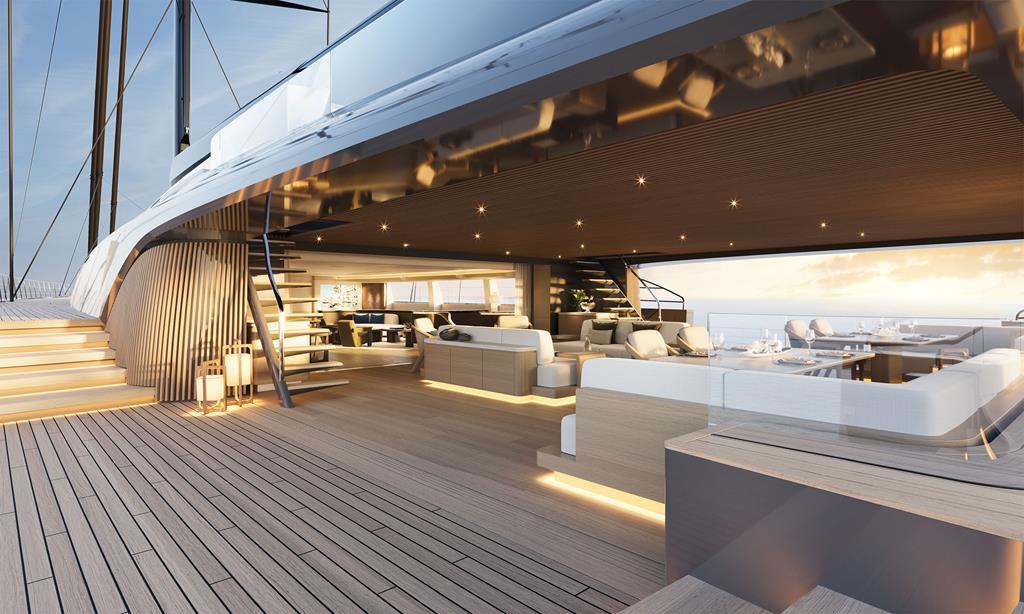 The sweeping aft cockpit envisioned for Royal Huisman’s planned 81m Project SKY (Image © Royal Huisman)
And then, at the end of the alphabet, comes Zero – perhaps the most consequential sailing yacht launched this decade. On 10 July, after seven years of study, engineering and construction, the 68.91m ketch touched water in Harlingen, in the Netherlands: the first vessel of her size and type designed to operate purely on harvested renewable energy, without compromising comfort or cruising range. “The build of Zero is unlike any other build we have ever undertaken,” says Bas Peute of Vitters, the shipyard in Zwartsluis responsible for her construction. “Not only are we constructing a yacht, but we are constructing a vision for the future.”
The numbers alone tell part of the story. There is no combustion engine aboard. Instead, Zero draws on a 250kW hydrogeneration system that harvests energy as she sails, hybrid photovoltaic-thermal panels, so-called breathing masts and a custom-designed micro-grid, all feeding 5.2 megawatt-hours of batteries weighing 28 tonnes – the fruit of some 60,000 hours of research and development and numerous prototypes. Aesthetes need not worry: function has not displaced beauty. Her Palma Blue hull and decks laid in Tesumo, a teak alternative, recall the golden age of sailing while proving that a fossil-fuel-free yacht need not settle for utilitarian styling. “If ever there was a boat that could change the status quo, this is it,” says Marnix Hoekstra, co-creative director at Vripack, which shaped her exterior and interior around naval architecture by Dykstra.
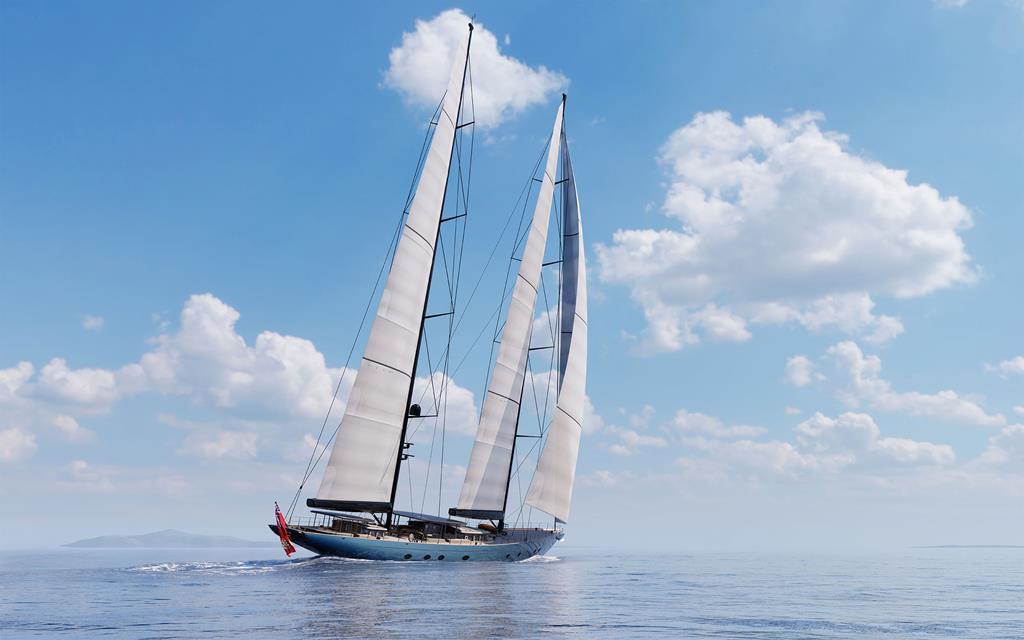 Vitters’ Zero, which operates entirely on renewable energy harvested aboard (Image © Vitters)
Tellingly, her launch is a beginning rather than an end. Zero now enters an intensive programme of sea trials, and the data she generates – together with research insights, software and system schematics – will be shared openly through the independent, non-profit Foundation Zero platform, so that her solutions can be adopted and refined across the superyacht sector and the wider maritime world.
“Fair winds and following seas,” runs the old mariner’s blessing. To every one of these projects, delivered or still on the drawing board, it seems the only fitting send-off.